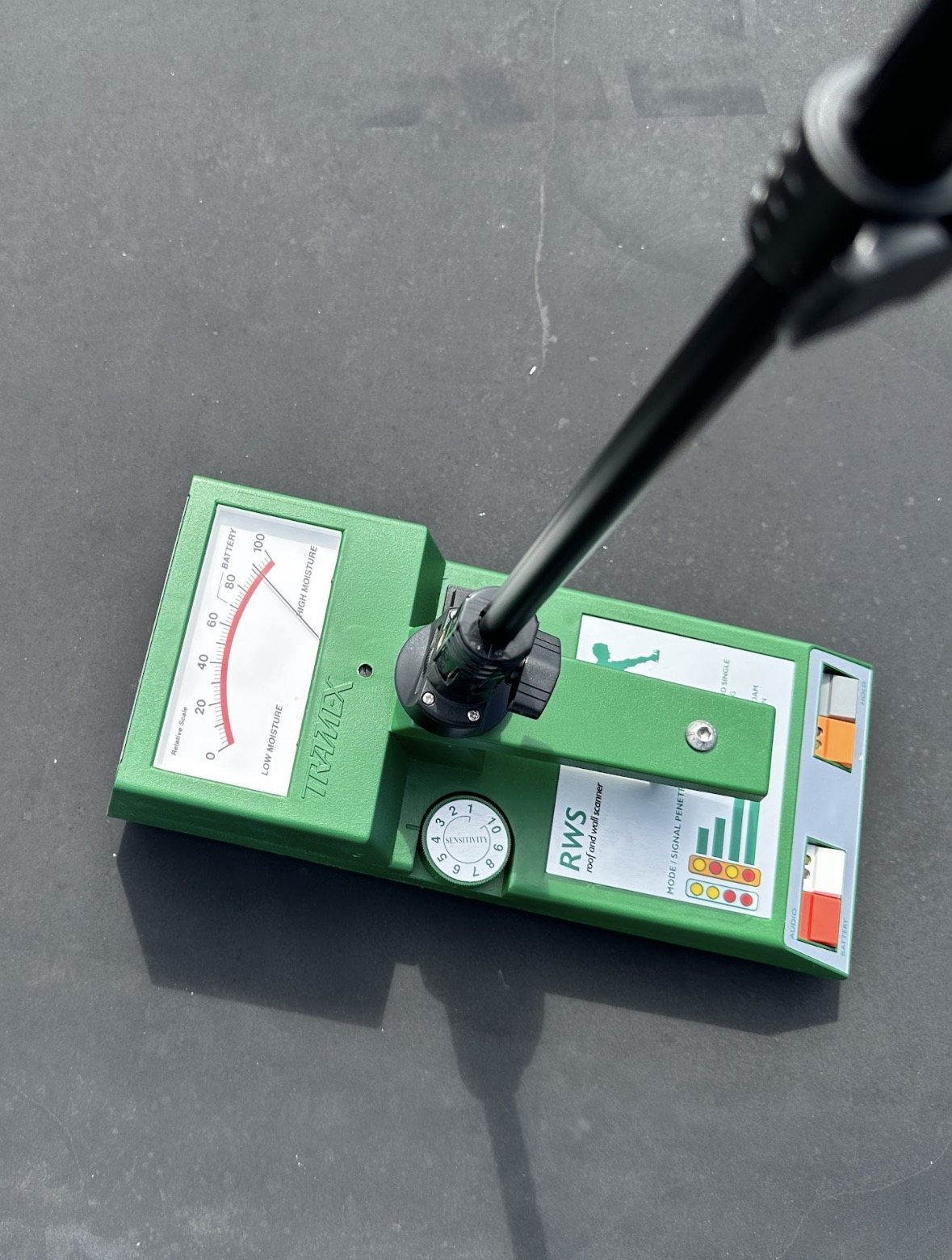
Non-Invasive Scanning
We scan the full roof surface using moisture detection equipment that identifies elevated moisture levels without penetrating or damaging the membrane.
Most contractors look at a roof with their eyes. WeldLab uses non-invasive moisture scanning on every inspection, mapping hidden water intrusion in TPO and PVC assemblies before recommending a single dollar of repair work.
Hidden moisture is the most common driver of recurring flat roof problems and the most commonly missed. Water that penetrates the membrane can travel laterally through insulation layers, saturating large areas far from the visible entry point. By the time a stain appears on an interior ceiling, the damage is often already significant.
Moisture enters through a failed seam or penetration, then migrates laterally through insulation. The visible stain and the actual entry point can be feet apart.
Saturated roof insulation loses its R-value, adds structural weight, and accelerates membrane degradation from beneath, creating a compounding failure cycle.
Patching without a moisture scan often treats the symptom while the underlying saturation continues spreading. The leak returns because the real source was never found.
Moisture saturation percentage is one of the most important factors in deciding whether a roof can be repaired or needs full replacement. Without a scan, the decision is a gamble.
WeldLab uses non-invasive moisture detection equipment on every inspection, mapping wet areas across the roof assembly before confirming scope. No cutting. No new penetrations. No guessing.
We scan the full roof surface using moisture detection equipment that identifies elevated moisture levels without penetrating or damaging the membrane.
Moisture findings are mapped by roof zone, identifying specific areas of saturation, the extent of lateral spread, and the relationship to rooftop features.
We classify wet areas by severity and urgency, helping you understand which zones require immediate action and which can be monitored and planned for later.
Moisture findings validate the actual repair boundary before any work is priced or executed, preventing under-scoping, over-scoping, and failed patches.
We review the roof system type, repair history, access logistics, and primary concerns before arriving, arriving prepared with the right equipment and questions.
A systematic walk of the full roof surface including membrane evaluation, drainage observation, penetration review, and non-invasive moisture scanning. All findings documented in real time.
Moisture findings are interpreted in the context of roof system condition, drainage patterns, and membrane age, determining the actual repair boundary, not just the visible symptom.
WeldLab tells you exactly what the roof needs: repair, maintenance, or replacement, then executes the work. One clear answer based on evidence, not a menu of options.
We prioritize scanning in high-risk zones, penetrations, drains, perimeter edges, where moisture most commonly enters flat roof assemblies.
Every repair scope is validated by moisture data before pricing. This prevents under-scoping (missed damage), over-scoping (unnecessary spend), and failed patches.
Chicago's lakefront and North Shore climate creates unique moisture behavior in flat roofing systems. We understand how local freeze-thaw cycles, lake exposure, and drainage conditions interact.
Our scans are fully non-invasive. No test cuts, no core samples, no membrane disruption. You get accurate moisture data without adding any new penetrations to your roof.
See Our Method in Action
WeldLab uses moisture scanning on every inspection, not as a product, but as the tool that confirms scope before any work begins. Expert inspection. One clear recommendation. Then we fix it.